John Lorito, Trevor O'Brien, "International Finance – Cash Pooling Arrangements", 2014 Conference Report, (Canadian Tax Foundation), 20:1-33

Descripton of physical and notional cash pooling (pp. 2-3)

[I]n general terms there are essentially two types of cash pooling arrangements [fn 1: …A representative listing…can be found…at www.rbinternational.com]: physical pooling, also known as zero-balancing, and notional pooling.

In a physical pooling arrangement, participants in the pool maintain their own bank accounts which are sub-accounts linked to a main or head account. …The head account is generally held by a different legal entity from the operating participants. …The participants carry out their daily activities, paying and receiving funds. At the end of each day, the accounts are "zero-balanced". Any positive balances in an account are transferred to the head account and any negative balances are funded from the head account such that each account, other than the head account, as a zero balance at the end of each day. The cash flows between the head-and participant accounts are generally treated as intercompany loans….

Notional pooling refers to the offset of interest income and expense that arises from the various cash positions in accounts that members of a multinational group maintain with a single bank….

Ordinary course exception for Canadian head account holder in cash pool (p. 16)

Where the Canadian resident corporation is the head account holder and therefore receives and makes loans and advances to the various cash pool members, it should be reasonable to conclude that such loans and advances were made in the ordinary course of the lender's ordinary business of lending money (provided this represents the ordinary business of the Canadian resident corporation). However, depending upon the terms of the cash pool, the loans and advances made under the cash pool may simply represent demand loans and therefore may not have any specific terms requiring repayment within a specific period of time….

Withholding based on net increase (p. 16)

If the shareholder loan rules apply to loans made by a Canadian resident corporation to a non-resident, and there is a series of loans and repayments, the CRA has indicated that the withholding tax payable as a result of the deemed dividend shall be "based on the net increase of the loan during the taxation year of the lender" [fn 51: IT-119R4…]. As a result, in a physical cash pooling arrangement that does not qualify to be exempted from the shareholder loan rules, it may be reasonable to treat the net increase in a physical cash pool balance over a particular taxation year as the amount that should be deemed to be a dividend paid and subject to Canadian withholding tax.

See description of cash pooling under s. 15(2.3).

Specified rights (defined as tantamount to ownership) rarely granted to creditors except re cash collateral (p. 9)

[I]n simple terms, a specified right is the right of a person to treat the property as it if it was the person's own property including the right to encumber and sell the property and to use the proceeds in whatever manner the person chooses. Such a right would rarely if ever be granted in respect of a property used to secure a debt or other obligation, except possibly in the case of cash collateral. Generally, a person who receives cash collateral to secure an obligation would typically have the ability to use the cash in any manner it chooses subject to the obligation to return an equivalent amount of cash when the obligation is extinguished.

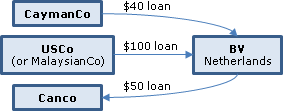
Unavailability of s. 212(3.3) where Canco owes $50 to Netherlands intermediary, which owes $40 to Caymanco and $100 to USCo – because U.S. withholding rate is 0% (p. 7)

At first glance, it seems [in this example] that the rule in subsection 212(3.3) may apply as there would appear to be two intermediary debts and, therefore, two non-residents to which interest is deemed to be paid, namely, USCo and CaymanCo. …[H]owever, the back-to-back loan rules do not apply in respect of the intermediary debt owing to USCo because the fourth condition [that the withholding tax would be greater if the interest was paid directly to USCo] does not apply.

…[If] USCo is replaced with a corporation resident in Malaysia…the withholding rate would be 15% [rather than 0%]. As a result…subsection 212(3.2) would apply to allow the taxpayer to designate amounts such that interest on 80 per cent of the Canco debt is deemed to be paid to the Malaysia corporation. …[S]ubstituting the Malaysian corporation for USCo has reduced the withholding tax… .

It seems to be a somewhat incongruous result that subsection 212(3.3) can be applied to reduce the withholding tax payable in a situation in which the second intermediary lender is resident in a jurisdiction in respect of which the withholding tax rate is higher than that of the jurisdiction of the intermediary but not if the second intermediary lender is resident in a jurisdiction in respect of which the withholding tax rate is lower than that of the jurisdiction of the intermediary.

Cash pooling advances in the ordinary course (pp. 19-20)

[I]n…2013-0483751C6, the CRA commented that…the ordinary course of business exception could apply "when a CRIC temporarily advances funds at risk in its business (i.e., the permanent removal of such funds would have a destabilizing effect on the business of the CRIC) to a [FA Corporation] if the resulting debt is repaid in the manner required by that exemption." Therefore, provided amounts advanced under a cash pooling arrangement are repaid within 180 days and the cash put on deposit with the cash pool is needed in the CRIC'S on-going operations, it may be possible for a CRIC to avoid the application of the Foreign Affiliate Dumping rules that would otherwise be applicable on advances made to its foreign affiliates under a cash pooling arrangement. The position suggested by the CRA with respect to operating cash placed on deposit in a cash pooling arrangement appears reasonable in that one would generally expect that, under a physical cash pooling arrangement, the head account holder should generally assume the role of banker and that the taxpayer should be treated on an equivalent basis as having placed funds on deposit with an unrelated bank, as it would have otherwise in the ordinary course of its business. It is understandable that the position suggested by the CRA specifically focused on "funds at risk in its business" as anything broader would have been inconsistent with the provisions of the Foreign Affiliate Dumping rules [fn 66: To discourage CRIC's controlled by NR Parents from making investments in FA Corporations.].

See description of cash pooling under s. 15(2.3).

Net decrease treated as repayment under cash pool (pp.16-17)

It is the position of the CRA [fn 52: …27 of IT-119R4…2006-021516117…and 990256… .] which is consistent with the decision in Edward C. Sargent v. MNR [fn 53: 83 DTC 572.] that repayments are to be treated on a first in first out basis unless the facts clearly indicate that the taxpayer intended a different allocation. However, in order for a repayment to be treated as a valid repayment for purposes of claiming a refund of withholding tax previously remitted, the repayment must not be made "as part of a series of loans or other transactions and repayments". [fn 54: Subsection 227(6.1).] …[U]nless facts indicate a different allocation, it would appear reasonable that a net decrease in a physical cash pool balance from the previous taxation year should be treated as a valid repayment and should be applied against the oldest outstanding "loan" balance (i.e., the oldest net annual increase to the cash pool for a taxation year that has yet to be repaid).

CRA relief where a cash pool head account has no presence in Canada and Canco has elected (p. 24)

Assume Canco…has elected to compute its Canadian tax results in US dollars. Canco is a wholly-owned subsidiary of USCo… the parent company of a multinational group and owns all the shares of BVCo, a corporation resident in the Netherlands. The multinational group has… a physical cash pooling arrangement wherein BVCo will be the head account holder.

Although BVCo may have no tax presence in Canada, as a non-resident corporation is unable to make a functional currency election, if BVCo were to be required to compute its Canadian tax results in a currency, that currency would have to be the Canadian dollar. As a result, for purposes of determining whether subsection 261(21) may be applicable to transactions entered into between Canco and BVCo under the cash pooling arrangement, it would appear that Canco and BVCo could be treated as being required to compute their Canadian tax results in different currencies. If this were to be the case and BVCo were to enter into a non-US dollar denominated transaction with Canco under the cash pooling arrangement, subsection 261(21) could require any income, gain or loss realized by Canco to be adjusted.

However, based on comments from the CRA, it would appear that subsection 261(21) should not be applicable to transactions entered into between a Canadian resident corporation and a related non-resident where the non-resident does not have a taxable presence in Canada…. [Citing 2014-0561001R3 above]

See description of cash pooling under s. 15(2.3).

Exclusion for loans to NR subs of related Canadian corporations (pp. 11-12)

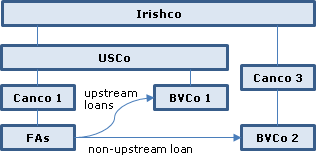
Consider…the structure…in which BVCo 1 [a NR sub of the immediate U.S. parent of Canco 1] is the head account holder. … Since BVCo 1 does not deal at arm's length with Canco 1 and is not a controlled foreign affiliate of Canco 1, BVCo 1 is a specified debtor in respect of Canco 1. As a result, any loans from a foreign affiliate…[subsidiary to Canco 1] will engage the application of the upstream loan rules in respect of Canco 1. By contrast, if BVCo 2 [a NR sub of a Cdn. sub of the ultimate NR parent of Canco 1] is the head account holder, loans from these foreign affiliates to BVCo 2 will not result in the application of the upstream loan rules. BVCo 2 is a controlled foreign affiliate of Canco 1 for purposes of section 17 by reason of the deeming rule in subsection 17(3) [f.n 36 This rule provides that a non-resident corporation that is a controlled foreign affiliate of a corporation resident in Canada is also a controlled foreign affiliate of any other corporation resident in Canada that is related to that corporation.] and, therefore, BVCo 2 is not a specified debtor in respect of Canco 1.

See description of cash pooling under s. 15(2.3).

Cash risked in active business (p.20:24-25)

Interest earned by a foreign affiliate on cash/deposits risked in the active business of the foreign affiliate should be treated as income that pertains to or is incident to that active business and therefore should not be included in computing its income from property. This should be the case irrespective of who is paying the interest, be it an unrelated bank or a related party as part of a cash-pooling arrangement.

Difficulties in establishing tracing in cash pool (p. 22)

It may be possible for interest earned by a foreign affiliate from deposits/loans made under a cash pooling arrangement to be re-characterized to be income from an active business under subparagraph 95(2)(a)(ii) where the head account holder is another foreign affiliate, however, many complexities exist. The activities carried on by the head account holder associated with the cash pooling arrangement should be treated as an investment business. The principal business purpose of the head account holder relating to the cash pool is to earn interest income by borrowing funds from some members of the cash pool and on-lending such funds to other members. As a result, any income earned by the head account holder should be income from property unless such income separately qualifies to be re-characterized to be income from an active business under subparagraph 95(2)(a)(ii).

If the head account holder is a foreign affiliate and it lends all the funds advanced to it under the cash pooling arrangement to other foreign affiliates to fund their active businesses, it should be reasonable to expect that all the interest income earned by the head account holder under the cash pooling arrangement should qualify to be re-characterized to be income from an active business, and correspondingly, all the interest paid by the head account holder to other foreign affiliates should also qualify to be re-characterized to be income from an active business of the other foreign affiliates. However, the odds of such perfect lending symmetry ever being achieved in a physical cash pooling arrangement is likely extremely low.

As deposits are made into the cash pool, there is generally no guarantee that another member in I the pool will require additional funding at that time, as a result, the head account holder may invest such deposits into short-term securities, etc. The income generated from such short term investments should be earned as part of the head account holders investment business and should be treated as income from property….

See description of cash pooling under s. 15(2.3).