Principal Issues: Whether the proposed transaction qualifies for the butterfly exemption found in paragraph 55(3)(b)
Position: Yes
Reasons: The proposed transaction meets the requirements found in paragraph 55(3)(b), and is not subject to any of the butterfly exemption denial rules found in 55(3.1)(a), (b) and (c)
Submitted by Anonymous (not verified) on Sun, 11/29/2015 - 02:15
real estate development properties transferred by charitable organization to LP held by discretionary trust of which it is beneficiary
Structure
A charitable organization ("Oeuvre") which is a registered charity holds various vacant lands with development potential. It has...
The text of this content is paywalled except for the first five days of each month. Subscribe or log in for unrestricted access.
Principales Questions:
1.Whether the proposed transactions, in and of themselves, would be considered activities that would constitute the carrying on a business that is not a related business of the Charitable Organization for the purposes of paragraph 149.1(2)a)?
2.Whether GAAR is applicable where a trust is used by the Charitable Organization to participate in a business venture in order to avoid the rules in paragraph 149.1(2)(a)?
Principal Issues: Whether the change in legal title of the property will trigger a disposition resulting in a capital gain to the taxpayer under the Income Tax Act ("the Act")?
taxable benefit on employer payment of RRSP (including LIRA) and TFSA fund management fees but not those of DPSPs or SERPs
68
Principales Questions: Whether the payment, by an employer, of management fees relating to certain retirement plans sponsored by the employer (DPSP, RRSP TFSA, unfunded SERP and LIRA) result in a taxable benefit for the employees who are beneficiaries under the plan?
Position Adoptée: Yes, in the case of RRSP, TFSA and LIRA.
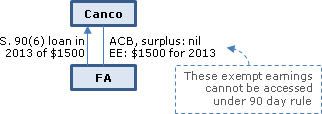
Principal Issues: The application of the upstream loan rules in subsections 90(6) to 90(15) in the following scenarios. Scenario1: For the purposes of determining the deduction under subsection 90(9), will the "90-day" rule in paragraph 5901(2)(a) of the Regulations apply to the notional dividend contemplated in paragraph 90(9)(a)? Scenario 2: For the purposes of determining the deduction under subsection 90(9), can the taxpayer be considered to have taken all the necessary steps to have made the "disproportionate election" under paragraph (b) of the definition of "underlying foreign tax applicable" in subsection 5907(1) of the Regulations? Scenario 3: For the purposes of determining the deduction under subsection 90(9), can the taxpayer be considered to have taken all the necessary steps to have made the election in paragraph 5901(2)(b) of the Regulations that deems a dividend to be paid from pre-acquisition surplus? Scenario 4: For the purposes of determining the deduction under subsection 90(9), can the taxpayer be considered to have taken all the necessary steps to have made the election in subsection 5901(1.1) of the Regulations that deems a dividend to be paid from taxable surplus before hybrid surplus? Scenario 5: Are gains which are deemed to arise by virtue of the application of subsection 40(3) as a result of notional dividends between lower tier foreign affiliates relevant for the purposes of determining the deduction under subsection 90(9)? Scenario 6: Is there relief from a multiple income inclusion arising as a result of the transfer of a loan within a foreign affiliate group on the liquidation of the creditor foreign affiliate? Scenario 7: Where there is a series of loans and other transactions and repayments, would 90(6) apply to each loan in the series notwithstanding that there is no deduction under 90(14) in respect of the repayments in the series?
Reasons: Scenario 1: Clause 90(9)(a)(i)(A) refers to the "exempt surplus at the lending time in respect of the corporation of a foreign affiliate of the corporation". The Technical Notes to subsection 90(9) also specify that the earnings of the foreign affiliate after the date of the Loan are not to be considered for the purposes of determining the deduction under subsection 90(9). See also 2014-0526721C6. Scenario 2: Canco could be considered, hypothetically, to have taken all the necessary steps to make the disproportionate election. This view is consistent with the Technical Notes. Scenario 3: Since Canco would have been in a position elect under paragraph 5901(2)(b) of the Regulations, it is our view that for the purposes of subsection 90(9) an amount may "reasonably be considered to have been deductible in respect of the dividend under paragraph 113(1)(d). Scenario 4: Since Canco would have been in a position to make an election under subsection 5901(1.1) of the Regulations, it is our view that for the purposes of subsection 90(9) an amount may "reasonably be considered to have been deductible" in respect of the dividend under paragraph 113(1)(b). Scenario 5: The provisions of subsection 90(9) contemplate only the actual ES, HS, HUT, TS, UFT and ACB amounts at the lending time. This view is consistent with the Technical Notes. As FA1 has no HUT there can be no amount determined under clause 90(9)(a)(i)(B). Scenario 6: Subsection 248(28). Scenario 7: Consistent with our position on subsection 15(2) as described in Interpretation Bulletin IT-119R4. See 9219115.
shrinking of CCPC control group likely was AOC if sufficiently material
372
Principales Questions: 1) Whether an acquisition of control of a corporation arises where three out of seven shareholders of the corporation sell their shares directly to another shareholder. 2) Whether an acquisition of control of the corporation arises where the departing shareholders sell their shares indirectly to another shareholder. 3) Whether an acquisition of control of the corporation arises where the three departing shareholders sell their shares to the remaining shareholders in proportion to their interest in the corporation.
Position Adoptée: 1) Yes. 2) Yes. 3) Most probably yes.
Raisons: 1) A group does not control a corporation when a single person controls the corporation (Southside Car Market) 2) Indirect control must be considered. 3) Examination of the circumstances of the given situation.
s. 42(1)(b)(ii) payments currently do not qualify as BILs
84
Principales Questions: Est-ce qu'une perte en capital réputée conformément à l'article 42 pourrait se qualifier à titre de PTPE pour un particulier?/Whether a deemed capital loss under section 42 can be qualified as BIL for an individual?
Position Adoptée: Pour les dépenses payées ou payables après la date d'échéance de production, effectuées dans une année d'imposition qui se termine après le 27 février 2004 et avant le 5 novembre 2010, oui, si toutes les conditions de l'alinéa 39(1)c) sont satisfaites. Pour les autres années d'imposition, non./ For expenses paid or payable on or before the filing-due date, incurred in taxation years that end after February 27, 2004 and before November 5, 2010, yes, if all conditions of paragraph 39(1)c) are met. For other taxation years, no.