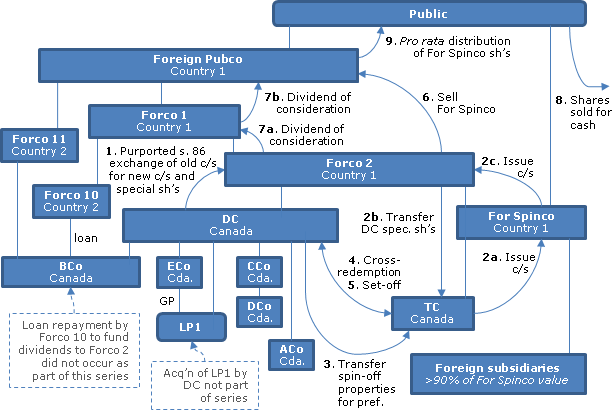
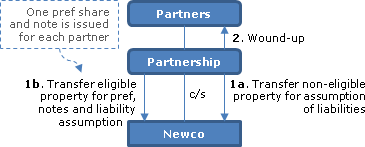
former partners providing services through separate corporations to a Newco replacement of their professional partnership
370
Principal Issues: Whether the incorporation of a professional partnership and the subsequent contracting out of the professional services of the new corporation to the professionals/shareholders will result in the application of the small business deduction limitations for "personal services business" or the "specified partnership income."
Position: No.
Reasons: The facts and proposed transactions are consistent with other rulings given on these issues.
copyright royalty for music used in film is exempt notwithstanding s. 212(5) exclusion
251
Principales Questions: 1) Est-ce qu'un montant versé à une personne non-résidente au titre d'une redevance afférent à un droit d'auteur sur une oeuvre musicale est exempté de l'impôt de la Partie XIII en vertu du sous-alinéa 212(1)d)(vi) 2) Si oui, est-ce que le paragraphe 212(5) s'applique lorsque la redevance se rapporte à une oeuvre musicale produite dans le contexte d'un film cinématographique?
Position Adoptée: 1) Oui. 2) Question de fait.
Raisons: 1) Une redevance afférent à un droit d'auteur sur une oeuvre musicale n'est pas assujetti à la retenue d'impôt de la Partie XIII aux termes du sous-alinéa 212(1)d)(vi). 2) Si les faits démontraient que le montant de redevance a été versé spécifiquement au titre ou en paiement intégral ou partiel d'un droit d'auteur concernant la production ou la reproduction de l'oeuvre musicale, il serait exclu du champ d'application du paragraphe 212(5) LIR même si l'oeuvre musicale a été produite ou reproduite dans le contexte d'un film cinématographique.
Principal Issues: How is the 2013 amendment to the definition of the start times for the adoption period applied? Is the definition applicable to an adoption period that starts before 2013; or only to an adoption period that begins in 2013 or later?
Position: The adoption period as defined by the 2013 amendment can start before 2013.
Principal Issues: Can two individuals claim a portion of the property tax amount for purposes of the Ontario energy and property tax credit where they each pay a portion of the property taxes on the principal residence?
Position: Depends on the facts, but likely not in this situation.
Reasons: An individual cannot include municipal taxes paid to determine occupancy costs if the individual is neither a beneficial owner nor an individual who pays rent, however, the beneficial owner of the residence for whom the payments were made may be able to include those amounts to determine his or her occupancy costs.
153(1)(g), 110.6(1) "Qualified Small Business Share", ITR 105, 248(1)
Principal Issues: 1) Whether a Canadian-controlled private corporation ("OPCO") shall withhold tax on a payment to a non-resident person for a commission and referral fee in respect of services rendered outside of Canada. 2)Whether OPCO shares qualify as Qualified Small Business Corporation Shares ("QSBCS") as that term is defined in subsection 110.6(1) if OPCO is carrying on an active business in Canada and outside Canada.
Position: 1) Commission and referral fees are not subject to Canadian withholding under Regulation 105 when no service is rendered in Canada. 2) Depends on the facts.
Reasons: 1. Services are not rendered in Canada by non-residents. 2. Conditions stated in the Act.
Submitted by Anonymous (not verified) on Sun, 11/29/2015 - 02:11
beneficiary dispute/renunciation
The Manitoba Pension Benefits Act (PBA) provides that notwithstanding any beneficiary designation under a registered pension plan, a deceased RPP...
The text of this content is paywalled except for the first five days of each month. Subscribe or log in for unrestricted access.
Principal Issues: In a situation where there is a legal dispute concerning who is a deceased RPP member's common-law partner at the time of the RPP member's death, who is required to include the RPP death benefit in income?
Position: The taxpayer who is legally entitled to receive and is paid the pension benefit.
Reasons: Question of fact/law concerning who is a taxpayer's legal common-law partner at the time of the taxpayer's death. Paragraph 56(1)(a) requires a taxpayer receiving a superannuation of pension benefit in a year to include the pension in the taxpayer's income in the year received.
Submitted by Anonymous (not verified) on Sun, 11/29/2015 - 02:12
dividend refund for partnership dividend compensation payments
How does s. 260(11)(c) apply to a professional corporation that is a member of a partnership respecting a dividend refund claim for dividend...
The text of this content is paywalled except for the first five days of each month. Subscribe or log in for unrestricted access.
Principal Issues: How does paragraph 260(11)(c) apply to a corporation that is a member of a partnership for purposes of claiming a dividend refund on dividend compensation payments paid by the partnership?
Position: Generally, pursuant to paragraph 260(11)(c) of the Act, a private corporation that is a member of a partnership is deemed, for the purposes of applying the dividend refund rules in section 129 of the Act, to have paid its specified proportion of the dividend compensation payments made by the partnership.
Principal Issues: (i) Whether assistance provided by a private XXXXXXXXXX school (elementary and high school) would be taxable to the student and whether the school is required to provide a T4A to these students?
(ii) Would discounted tuition provided to faculty member's children be a taxable benefit to the faculty member?
Position: (i) The types of assistance provided would likely be considered bursaries under 56(1)(n) and would therefore be taxable to the student to the extent that the amount received exceeds the individual's scholarship exemption. The school would be required to provide T4A's for the amount of assistance provided.
(ii) No.
Reasons: (i) Where the primary purpose of the assistance provided is to enable an individual to pursue an education, the amount of the assistance would be considered to be a bursary.
(ii) Subparagraph 6(1)(a)(vi) excludes amounts provided to a family member of a taxpayer by the taxpayer's employer that assists the family member in furthering their education
Principal Issues: Employee had transferred a lump sum from his previous employer's pension plan to a RRSP. Whether employer contributions have vested for the purposes of clause 60(j.1)(ii)(B)?
Position: Yes.
Reasons: Contributions have vested because the transferred lump sum included the employer's contributions.
Submitted by Anonymous (not verified) on Sun, 11/29/2015 - 02:11
Hong Kong pension received by Canadian resident
S. 56(1)(a)(i) of the Act extends to benefits from a foreign pension plan that are attributable to services rendered while the individual was not...
The text of this content is paywalled except for the first five days of each month. Subscribe or log in for unrestricted access.
Principal Issues: Whether receipts from a Hong Kong pension plan are taxable in Canada under the Canada-Hong Kong Tax Convention?
Position: Yes.
Reasons: Art. 17 of the Tax Convention allows Hong Kong to tax amounts from pensions (including lump sums) arising in Hong Kong, but this does not eliminate Canada's right to tax the same amounts.
Principal Issues:
1. Should the reimbursement of real estate and legal fees with respect to the sale of a taxpayer's rental property give rise to a taxable employment benefit in the circumstances provided?
2. Are long-term storage costs deductible moving expenses under subsection 62(3) of the Act?
Position:
1. In this case, yes.
2. No.
Reasons:
1. Where an employer pays or reimburses an employee for relocation expenses that would have otherwise qualified for a moving expense deduction under subsection 62(1), such payment or reimbursement will generally not result in a taxable benefit to the relocated employee under paragraph 6(1)(a). In this case, the selling costs would not qualify for a moving expense deduction under subsection 62(1) of the Act and therefore, the reimbursement is a taxable employment benefit.
2. Under subsection 62(3), deductible moving expenses include any expense incurred as or on account of "the cost to the taxpayer of transporting or storing household effects in the course of moving from the old residence to the new residence." In this case, the long-term storage costs are not incurred "in the course of moving" and are therefore not deductible as a moving expense under section 62.
Submitted by Anonymous (not verified) on Sun, 11/29/2015 - 02:12
equipment installation project of Franceco lasting more than 12 months including preparing specs and final testing
Franceco was engaged to install specialized equipment purchased by an arm's length Canadian company (Canco) for modernizing and expanding the...
The text of this content is paywalled except for the first five days of each month. Subscribe or log in for unrestricted access.
Principales Questions: Whether a non-resident corporation has a permanent establishment in Canada at a particular time pursuant to paragraph 3 of Article 5 of the Canada-France Convention?
Position Adoptée: Yes.
Raisons: During the period related to the Project, the non-resident corporation had a permanent establishment as it carried on business through an installation project which lasted more than twelve months.