Principal Issues: Will the rights to shares granted by the employer company be subject to the deemed disposition rules in paragraph 128.1(4)(b) of the Act when the employee emigrates from Canada?
Position: No.
Reasons: The rights are exempted from the deemed disposition rule by subparagraph 128.1(4)(b)(iii) of the Act since they fall into the definition of "excluded right or interest" in subsection 128.1(10) pursuant to paragraph (c) thereof.
Principal Issues: 1) Whether offshore commercial fishers are permitted to deduct food expenses based on a per diem rate per sharesperson? 2) Whether the deductible portion of meal expenses may be determined with reference to subsection 67.1(1.1) of the Income Tax Act?
full amount of designated dividend reduces payor's GRIP even though recipient's GRIP increased only by safe income portion
272
Principal Issues: 1. Opco designates a portion of a dividend it pays to Gesco to be an eligible dividend. Because of the application of subsection 55(2), Gesco is considered to have received a dividend of a lesser amount than the portion designated by Opco. Whether the GRIP of Opco will be reduced by the portion designated. Whether the GRIP of Gesco will be increased by an amount different from the amount of the reduction of the GRIP of Opco.
2. If Opco designates a portion of a dividend it pays to Gesco equal to the amount of the dividend considered to have been received by Gesco after the application of subsection 55(2) (but not higher than the GRIP of Opco), whether the GRIP of Gesco will be increased by the amount of the dividend considered to have been received by Gesco after the application of subsection 55(2).
Position: 1. The GRIP of Opco will be reduced by the portion of the dividend it pays to Gesco that was designated to be an eligible dividend. However, the GRIP of Gesco will be increased by the amount of the dividend considered received by Gesco after the application of subsection 55(2), which amount is less than the portion designated by Opco.
2. The GRIP of Gesco will be increased by the amount of the dividend considered received by Gesco after the application of subsection 55(2), which amount is equal to the portion of the dividend designated by Opco.
Reasons: 1. Wording of the Act and previous position.
2. Textual, contextual and purposive interpretation of the GRIP, of subsection 89(14) and of subsection 55(2).
Principal Issues: Whether a non-transport employee making an otherwise allowable claim for meals under paragraph 8(1)(h) of the Act is entitled to use the simplified method described in IC 73-21R9.
Submitted by narmstrong on Wed, 02/15/2017 - 02:59
reimbursement for travel between home and regular place of employment is taxable benefit, but not where between RPEs
If an individual has multiple regular places of employment (RPE) and travels between them during the day, the trip from the individual’s home to...
The text of this content is paywalled except for the first five days of each month. Subscribe or log in for unrestricted access.
Principal Issues: 1. Whether a taxable benefit arises for employee travel between home and a work location where an employee has multiple work locations and multiple employers? 2. Whether an employee can deduct travel expenses under the same set of facts?
Submitted by Anonymous (not verified) on Sun, 11/29/2015 - 02:13
flunked 4 of 6 religious order criteria
An organization did not appear to qualify as a religious order as there was no indication of financial self-sacrifice or more rigorous working...
The text of this content is paywalled except for the first five days of each month. Subscribe or log in for unrestricted access.
Principal Issues: Whether an organization is a religious order for purposes of the clergy residence deduction provided by paragraph 8(1)(c) of the Act?
Submitted by Anonymous (not verified) on Sun, 11/29/2015 - 02:14
parents' donate to foundation to reduce teachers' ticket prices
A private charitable foundation, associated with a private school, holds a fundraising gala for the benefit of the school. The teachers are urged...
The text of this content is paywalled except for the first five days of each month. Subscribe or log in for unrestricted access.
Principal Issues: Are teachers in receipt of a taxable benefit where parents donate money to a private charitable foundation to assist teachers in paying for tickets to a gala fundraiser that benefits the private school where they teach?
Submitted by Anonymous (not verified) on Sun, 11/29/2015 - 02:12
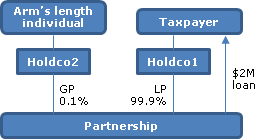
partner loan to partnership with joint and several partner liability
A Canadian resident makes a loan to a general partnership of which he is member and non-residents also are members. CRA stated that "the rule in...
The text of this content is paywalled except for the first five days of each month. Subscribe or log in for unrestricted access.
Principal Issues: Is indebtedness owed by a general partnership (some of the members of which are persons not resident in Canada) to a Canadian resident, "specified foreign property" of the Canadian resident within the meaning of paragraph (g) of the definition of that term in subsection 233.3(1) of the Act?
Position: Yes.
Reasons: In the context of applying paragraph (g) of the definition of "specified foreign property" in subsection 233.3(1) of the Act, subsection 96(1) of the Act does not apply and the general partnership is not considered a separate person. In addition, there is no other provision in the Act which deems a partnership to be a separate person for the purposes of paragraph (g) of the definition of "specified foreign property" in subsection 233.3(1) of the Act. Therefore, each of the non-resident partners would be viewed as the debtors in respect of the full amount of the loan for the purposes of applying paragraph (g) of the definition of "specified foreign property" in subsection 233.3(1) of the Act.
diplomatic exemption/discretion if property sold at loss
129
Principal Issues: Is a diplomatic agent exempt from a penalty under 162(7) as a result of filing a notice of disposition late?
Position: No.
Reasons: The exemption in Article 34 relates to dues and taxes on immovable property held on behalf of the sending State for the purpose of the mission. The property, in this case, was not for the purpose of the mission. Furthermore, the diplomatic agent had left Canada and therefore the privileges and immunities no longer applied.
Principal Issues: Whether the income included under section 110.5 and a foreign tax credit provided by subsection 126(1) or 126(2) would be permissive amounts under IC84-1?
accrual of interest until filing of s. 216(4) return
189
Principal Issues: Where there has been a failure to withhold under Part XIII followed by a 216 election to file under Part I, at what point does interest stop accruing on the Part XIII assessment?
Position: Interest on section 215 amounts will accrue until the section 216 elective filings have been made. After that point, interest will continue to accrue on any amount of Part XIII interest in arrears.
Reasons: On filing a Part I return under section 216, the Part XIII liability is replaced with a Part I liability. Following the Tax Court of Canada decision in Pechet, the process is contemporaneous so that the interest on the subsection 215 amounts would not continue to accrue beyond the point where the ultimate tax debt was settled. A 216 return effectively settles the Part XIII tax by replacing it with a Part I liability. Interest arrears on the original Part XIII tax remain owing until the 216 filing, and interest will continue to accrue on those arrears after the 216 filing.
Submitted by Anonymous (not verified) on Sun, 11/29/2015 - 02:16
carry-forward to subsequent year within 10 years
If the taxpayer had recognized the non-discretionary s. 34.1(3) deduction in a year that was now beyond the 10-year limitation in s. 152(4.2), it...
The text of this content is paywalled except for the first five days of each month. Subscribe or log in for unrestricted access.
Principal Issues: Whether the Minister may recognize a non-capital loss that was not previously reported by a taxpayer in a taxation year that is statute-barred, and therefore, increase the non-capital loss carry forward available to be applied to a future taxation year that is not statute-barred.
Position: Yes, provided a loss determination under 152(1.1) has not been issued for the taxation year the non-capital loss was incurred.
Reasons: A non-capital loss exists whether or not the loss has been reported in the tax return for the taxation year when it was incurred, despite the fact that such taxation year cannot be reassessed.
Submitted by Anonymous (not verified) on Sun, 11/29/2015 - 02:17
s. 162(5) or (7) choice
Respecting whether the penalty under s. 162(5) or (7) should be imposed where foreign reporting forms (e.g., T1134, T1135 or T1142) were...
The text of this content is paywalled except for the first five days of each month. Subscribe or log in for unrestricted access.
Principal Issues: Whether a prescribed form which is filed without the required information and/or documentation would be subject to a penalty, even though it was filed on or before the filing deadline?
Position: Yes, subsection 162(7) or 162(5) would apply depending on whether the missing information affects the substance of the form.
Reasons: In situations such that the prescribed form is substantially incomplete, whether missing relevant information or required documents, the form may be considered as invalid and will not be accepted as filed, and the penalty provided by subsection 162(7) for the failure to file the information return as and when required by the Act would be applicable. In situations where the form is filed prior to the filing deadline, but it is missing information which does not affect the substance of the form, a penalty provided by subsection 162(5) is applicable for the failure to provide information required on a prescribed form.