Submitted by Anonymous (not verified) on Sun, 11/29/2015 - 02:12
applies to dividends deemed to be interest
The Corporation, a "mortgage investment corporation" under s. 130.1(6), pays dividends which take into account, inter alia, its income and...
The text of this content is paywalled except for the first five days of each month. Subscribe or log in for unrestricted access.
Principal Issues: Whether a favourable ruling could be issued that the deemed interest payments paid to non-resident shareholders of a MIC would not fall within the meaning of PDI such that the payments would be exempt from Part XIII tax.
Position: We were unable to provide a favourable ruling.
Reasons: The deemed interest payments met both the obligation test and the participation conditions described in the definition of PDI in Part XIII. The words of paragraph 214(3)(e) that deem the deemed interest to be paid on a bond (an obligation) are sufficient to consider that interest was paid on an obligation for the purposes of the definition of PDI. The dividends paid from the Corporation that are deemed to be interest, were computed by reference to the taxable income, profit, cash flow or other similar criterion described in the definition of PDI.
Principal Issues: Whether expenditures made by a taxpayer to develop a website would be a capital or current expense.
Position: Where the website will only have a relatively short useful life the related costs should be treated as a current expense. However, if the website is expected to have a long useful life then the costs should be treated as a capital expense.
Reasons: Guidelines explained in the Interpretation Bulletin IT-128R, entitled Capital Cost Allowance - depreciable property at paragraph 4.
The text of this content is paywalled except for the first five days of each month. Subscribe or log in for unrestricted access.
Principal Issues: 1. Whether an amendment to a debt obligation to extend its term for a commercially reasonable period would result in the loss of the transitional relief available for RCA prohibited investments acquired before March 29, 2012? 2. Whether a partial payment of a debt at maturity would result in the loss of the relief for the remaining balance?
Position: 1. No, provided (i) the debt obligation has not yet been settled, (ii) the amendment is made in 2013, and (iii) the new amortization period is consistent with the other terms of the debt obligation, the whole of which establish commercially reasonable payments of principal and interest at least annually. 2. No, provided (i) the existing debt is not fully extinguished, and (ii) the remaining balance of the debt is subject to commercial terms.
Reasons: Falls within the scope of the transitional rule that accommodates modifications to debt obligations to provide for commercial normalcy.
Principal Issues: A unit trust with many unitholders plans to designate a certain portion of its income under subsection 104(13.1). Would a letter setting out the names of the beneficiaries and a general statement of the income to be taxed in the unit trust be sufficient for purposes of the 104(13.1) designation?
Position: No
Reasons: The 104(13.1) designation is made for each beneficiary and will generally reduce the adjusted cost base of each beneficiary's capital interest in the unit trust.
Submitted by Anonymous (not verified) on Sun, 11/29/2015 - 02:15
Subsection 107(2.002) lacks a prescribed form. For the taxation year in which the non-resident trust distributes property, the beneficiary should...
The text of this content is paywalled except for the first five days of each month. Subscribe or log in for unrestricted access.
Principal Issues: How to file a subsection 107(2.002) election where there is no prescribed form available.
Position: The beneficiary should send a letter attached to the return of income for the year of the distribution. Where the beneficiary files the return of income electronically the election, which can not be filed electronically, must be sent to the CRA separately.
renunciation must take effect before the death of the deceased and is unavailable to estate
211
Principal Issues: Where the death of an individual occurs in the year he acquired flow-through shares, whether a deduction for the CEE or CDE renounced by the resource corporation or an investment tax credit for flow-through mining expenditures will be available on the final return of the deceased.
Position: A corporation may only renounce its CEE and CDE incurred in favour of the individual who acquired the flow-through shares. A renunciation in favour of an individual cannot be made effective after the death of that individual. The renunciation is in respect of the expenses that are incurred on or before the effective date of the renunciation. Therefore, the deceased person may have the right to deduct CEE or CDE in his final tax return or to claim an investment tax credit depending on the circumstances (the effective date of the renunciation, for example). However, the estate of the individual or the beneficiaries of the estate will not benefit from any renunciation with respect to shares acquired by the deceased.
Reasons: The renunciation has to be made in favour of the person who acquires the flow-through shares. Upon death, the person ceases to exist and the corporation cannot renounce in favour of a person who ceases to exist. Wording of the Act and previous position.
employment by employees of partnership of corporations is treated as joint employment by those corporations
90
Principal Issues: Whether a 40% shareholder of a corporation which is an employee of a partnership in which the corporation is a partner has an insurable employment for the purposes of the EIA where the other partner of the partnership is another corporation 40% of the shares of which are held by another person?
Submitted by narmstrong on Sun, 03/25/2018 - 18:59
s. 94 trusts were resident in Canada for Treaty purposes even before Income Tax Conventions Interpretation Act amendment, which precludes application of tie-breaker
How would the Canada-U.S. Tax Convention(the "Convention") tie-breaker rules apply in a double residency case under the Convention and how could...
The text of this content is paywalled except for the first five days of each month. Subscribe or log in for unrestricted access.
s. 94 trusts were resident in Canada for Treaty purposes even before Income Tax Conventions Interpretation Act amendment, which precludes application of tie-breaker
339
Principal Issues: How does the CRA apply the tie breaker rules provided by the Canada-U.S. Tax Convention in the context of a (1) double statutory residency of a trust and (2) a double residency of a trust under section 94 of the Act?
Position: (1) The double statutory residency of a trust will generally be settled by the competent authorities on a case-by-case basis, pursuant to the subsection IV(4) of the Canada-U.S. Tax Convention. In order to establish the residency of a trust, the Canadian Competent Authority may consider, among others, the settlor and beneficiaries' residency, the location of the trust's assets, the reason why the trust has been settled in a particular country, etc.
(2) The CRA considers that a deemed resident trust under section 94 is resident of Canada for the Tax Conventions' purposes and such rule is established in the new section 4.3 of the Income Tax Conventions Interpretation Act. In a case of a double taxation, a foreign tax credit calculated under the provisions of paragraph 94(3)(b) and section 126 will be available to the trust.
Reasons: Application of the Act, the Canada-U.S. Tax Convention, the Income Tax Conventions Interpretation Act and previous interpretations.
Submitted by narmstrong on Fri, 03/30/2018 - 15:14
s. 104(19) designation unavailable for employee trust or employee benefit trust
An employee trust (the "Trust") holds shares of a taxable Canadian corporation (the “Corporation”) that then redeems shares that had not been...
The text of this content is paywalled except for the first five days of each month. Subscribe or log in for unrestricted access.
Principal Issues: Whether a corporation that is a beneficiary of an employee trust can deduct an amount pursuant to subsection 112(1) with respect to a dividend received by an employee trust that is paid to the corporation.
Position: No.
Reasons: If the trust is an employee trust, as defined in subsection 248(1), no amount will be added to its income pursuant to subsection 104(13). In the particular circumstances, the amount received by the corporation will not be added to its income pursuant to 104(14) or to section 105. Therefore, subsection 104(19) will not apply and the amount received by the employee trust and paid to the corporation will not be deemed to be a dividend received by the corporation for the purposes of subsection 112(1).
Submitted by narmstrong on Fri, 03/30/2018 - 16:53
capital gains from CGD-eligible property are separately allocated to partner
Where a partnership has realized only $150,000 in capital gains from the disposition of capital property eligible for the capital gains deduction...
The text of this content is paywalled except for the first five days of each month. Subscribe or log in for unrestricted access.
Principal Issues: If a partnership has both capital gains otherwise eligible for CGE for members of the partnership and capital losses in a taxation year, does it allocate separately the gain on the one it had and the loss on the other hand to its partners or does it allocate the gain/loss?
Position: Partnership allocates the gain and the loss separately.
Reasons: Net capital gains/losses eligible for CGE are determined at partner level.
Principales Questions: 1) Whether the transfers of two Individual Retirement Accounts (IRA) to an RRSP would be considered as part of a series of periodic payments if the transfers are made in two different years?
2) Whether a transfer of a US 401(k) to two different IRA followed by the transfer to an RRSP would be eligible for the deduction pursuant to paragraph 60(j)?
Position Adoptée: 1) No if there is no other payment.
2) The fact that the amount in a foreign retirement arrangement originally came from a US 401(k) plan will not in itself prohibit the deduction under paragraph 60(j).
no disposition where shares exchanged for identical-attribute shares of a different class
229
Principales Questions: Whether the position stated in 2004-0092561E5 is still valid considering new subsection 49(3) of the Quebec Corporations Act under which two or more classes of shares with the same rights, privileges, conditions and restrictions may be issued?
Submitted by Anonymous (not verified) on Sun, 11/29/2015 - 02:15
s. 256(9) does not permit the parties to elect as to the actual time of acquisition of control
The questioner asserted:
It is generally accepted that the "particuar time on a day" when "control of a corporation is acquired" is the time at...
The text of this content is paywalled except for the first five days of each month. Subscribe or log in for unrestricted access.
Principal Issues: In the context of a sale of the shares of the capital stock of a corporation, whether subsection 256(9) could allow the vendor and purchaser of the shares (with a specific clause in their contract) to have an acquisition of control of the corporation at a particular time that is different than the point in time at which the purchaser acquires ownership of the shares of the capital stock of the corporation under the contract.
Position: No.
Reasons: Subsection 256(9) does not allow the parties (with a specific clause in their contract) to have an acquisition of control at a particular time that is different than the point in time at which the purchaser acquires ownership of the shares of the corporation.
Submitted by Anonymous (not verified) on Sun, 11/29/2015 - 02:15
purchase debt not issued to directly acquire shares
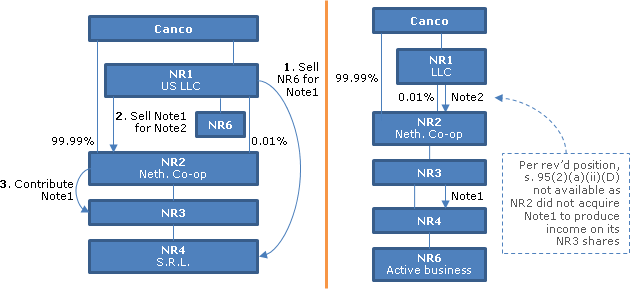
Following preliminary transactions, Canco held all the membership interest in a U.S. LLC (NR1) as well as 99.99% ownership of a [Netherlands?]...
The text of this content is paywalled except for the first five days of each month. Subscribe or log in for unrestricted access.
Principal Issues: Whether clause 95(2)(a)(ii)(D) ITA applies to the interest paid or payable by one foreign affiliate of a taxpayer to another of its foreign affiliate?
Position: No.
Reasons: Conditions set out in subclauses 95(2)(a)(ii)(D)(I) and (II) are not met as there is no money borrowed and no property acquired.
s. 248(5) requirement for a legal exchange is engaged by a reference to a substituted share
199
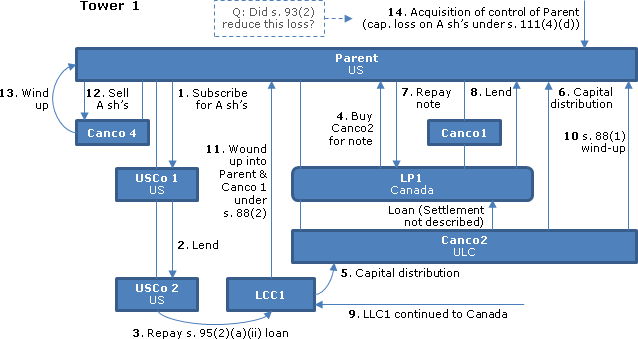
Principales Questions: Whether, in two particular situations involving the disposition by a taxpayer of affiliate shares, particular shares might be considered as shares for which the affiliate shares were substituted for the purpose of the determination of element B of the formula in paragraph 93(2.01)
Position Adoptée: No.
Raisons: Interpretation and application of the ITA to the facts submitted.