Submitted by Anonymous (not verified) on Sun, 11/29/2015 - 02:14
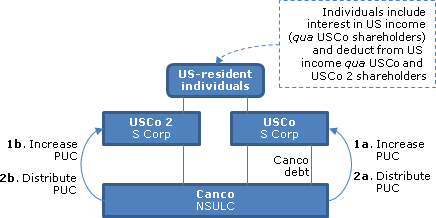
two-step distribution to two S-Corp shareholders of ULC/interest payment to one
USCo and USCo2 are each S Corporations whose shares are owned in the same proportions by U.S.-resident and qualifying-person individuals, who are...
The text of this content is paywalled except for the first five days of each month. Subscribe or log in for unrestricted access.
Principal Issues: 1. Whether subparagraph 7(b) of Article IV of the Canada-United States Income Tax Convention will apply to deny treaty benefits where a Canadian resident unlimited liability company that is fiscally transparent for United States tax purposes increases its paid up capital and subsequently makes a payment that reduces its paid up capital. 2. Whether subparagraph (7)(b) of Article IV of the Treaty will apply to deny treaty benefits where a Canadian resident unlimited liability company pays interest to its United States-resident shareholder?
Position: 1. No 2. No
Reasons: 1. Subsections 84(1) and 212(2) of the Income Tax Act will apply on the increase of paid-up capital. Tax treatment of the deemed dividend income under the taxation laws of the United States would be the same if the payer of the deemed dividend were not fiscally transparent. 2. Tax treatment of the interest payment under the taxation laws of the United States would be the same if the payer were not fiscally transparent.
18(1)(l), 9(1), 18(1)(h), 18(1)(b), 18(1)(a), 67, 248(1) "personal and living expenses"
Principal Issues: Whether expenses for travel from a cottage to the mainland by a boat owned by the taxpayer are deductible; whether expenses for using that boat to entertain clients are deductible
Submitted by Anonymous (not verified) on Sun, 11/29/2015 - 02:16
application to Public Trustee trust
An estate administered by the Public Trustee potentially could remain in existence for more than 21 years. Accordingly, there could be a deemed...
The text of this content is paywalled except for the first five days of each month. Subscribe or log in for unrestricted access.
Principal Issues: Whether the 21-year deemed realization rule applies where an estate holds gross royalty trust certificates on which income continued to be paid to the estate after the deceased's death.
Position: Yes, where the gross royalty trust certificates are capital in nature.
Reasons: Where gross royalty trust certificates are capital in nature, the 21-year deemed realization rule would apply pursuant to subsection 104(4) of the Act.
deduction for US tax on LLC income which also is FAPI
161
Principal Issues: 1. Is the US tax paid by the Canadian resident owner of an LLC considered to be foreign accrual tax in respect of the LLC?
2. Would the FAPI income which arises in the hands of the taxpayer be considered foreign source income and can a foreign tax credit then be claimed by the taxpayer against the FAPI inclusion?
Position: 1. No. 2. Yes, if the taxpayer is an individual. No, if the taxpayer is a corporation.
Reasons: 1. In order for an income or profits tax to qualify as foreign accrual tax, the tax must be paid by the particular affiliate (or any other affiliate of the taxpayer in respect of a dividend received from the particular affiliate). 2. Any amount included in income under subsection 91(1), would be considered income from sources in the US for purposes of subsections 20(11) and 126(1). However, any US tax paid in respect of a corporation's share of the income of an LLC would be paid by the corporation in respect of income from a share of the capital stock of a foreign affiliate of the corporation.
Principal Issues: Whether a subsection 20(11) deduction is available to an individual in respect of US tax paid on their share of income earned by a US LLC?
Position: Yes, if the individual received a distribution in the year from the LLC. Otherwise, no.
Reasons: In computing the individual's income from the shares of the LLC, there may be deducted under subsection 20(11) the amount, if any, by which the amount of the US tax paid by the individual exceeds 15% of the amount of the dividend income included in computing the individual's income for the year from the LLC.
Submitted by Anonymous (not verified) on Sun, 11/29/2015 - 02:14
The starting point in determining the amount of a foreign tax credit available to a part-year resident of Canada in respect of a particular...
The text of this content is paywalled except for the first five days of each month. Subscribe or log in for unrestricted access.
Principal Issues: Can part-year residents claim the foreign tax paid for the entire year as a foreign tax paid for purposes of the foreign tax credit?
Position: While the foreign non-business-income tax or business-income tax paid in respect of the full year is the starting point, the amount of foreign tax credit available to part-year residents is determined by the operation of the formulas in section 126. This is reflected on Form T2209 and explained in greater detail in Income Tax Folio S5-F2-C1, Foreign Tax Credit.
Submitted by Anonymous (not verified) on Sun, 11/29/2015 - 02:13
The first deemed disposition day of a pre-1972 non-spousal testamentary trust was deferred until January 1, 1999 through an exempt beneficiary...
The text of this content is paywalled except for the first five days of each month. Subscribe or log in for unrestricted access.
Principal Issues: Deemed disposition day of transferee trust on a trust-to-trust transfer where the trust's deemed disposition day was deferred to January 1, 1999.
Position: In this scenario, the earliest day determined under subparagraph 104(5.8)(a)(i) is the day determined under clause 104(5.8)(a)(i)(A).
Submitted by Anonymous (not verified) on Sun, 11/29/2015 - 02:15
The requirement in IT-169 that CRA be notified of the existence of a price adjustment clause was not carried over into S4-F3-C1, and no longer...
The text of this content is paywalled except for the first five days of each month. Subscribe or log in for unrestricted access.
Principal Issues: Whether a taxpayer's failure to notify the CRA of the existence of a price adjustment clause to an agreement compromises the effectiveness of the price adjustment clause?
Position: No
Reasons: The failure to notify the CRA of the existence of a price adjustment clause when filing a tax return will not, in and of itself, preclude the CRA from recognizing the effectiveness of a price adjustment clause
Principal Issues: Does CRA accept the Sommerer decision and can CRA provide guidance on when 75(2) will apply to transactions between an individual and a trust.
Position: Commentary provided on our view of impact of the decision and Budget 2013 changes to 75(2).
Art. XXIV(5) rules in US Treaty supplant s. 20(11) and (12) rules
117
Principal Issues: What credits and deductions are available to U.S. citizens resident in Canada on taxes paid in respect of dividend income now that rates have increased in conjunction with the "fiscal cliff".
Position: Elimination of double taxation is handled by Art. XXIV,5 Canada-US Treaty.
Principal Issues: 1. Is the employment income of Indian employees exempt under Guideline 4?
2. If not exempt under Guideline 4, will another Guideline or connecting factors apply?
Position: 1. No.
2. Guidelines 1, 2 and 3 may apply to a few employees. Overall, for most employees, the employment income is likely not connected to a reserve and is taxable.
Reasons: 1. The income does not meet the criteria in Guideline 4.
2. For the most part, this is an employee leasing situation. There does not appear to be sufficient benefits flowing to the reserve from the employers to connect the income to a reserve. One company does not appear to be resident on a reserve.