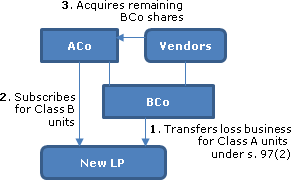
Principal Issues: Whether subsections 103(1) and (1.1) will apply to redetermine the allocation of any income or loss from the manner described in the partnership agreement.
Position: No.
Reasons: The allocation of income and loss is proportionate based on the ownership of units which is considered reasonable in the circumstances.
Principal Issues: Whether an employer IPP contribution made in Year 2, in respect of Year 1, is deductible in Year 2.
Position: Yes.
Reasons: An IPP contribution made in a taxation year in respect of periods before the end of that year is deductible, providing all of the other criteria in section 147.2 is met.
Principal Issues: (1) Whether a U.S. corporation is carrying on business in Canada pursuant to section 253 of the ITA. (2) Given the circumstances, is the U.S. corporation carrying on a business through a permanent establishment in Canada. (3) The U.S. corporation's Canadian filing requirements.
Position: Insufficient facts and information are provided for a definitive response to the questions. General comments are provided.
Reasons: Whether a non-resident corporation is carrying on business in Canada is a question of fact. If the U.S. corporation is carrying on business in Canada and meets the conditions of Article V(6) of the treaty, the U.S. corporation will not be carrying on business through a permanent establishment in Canada and will not be liable for Part I tax under the Act.
Canada-Germany Convention Article 18(3)(b), 56(1)(a)(i), 110(1)(f)(i), 81(1)(g), Treaties Article XVIII
Principal Issues: Are German reparation pension payments known as Wiedergutmachungs rente received by a Canadian resident taxable for Canadian tax purposes?
Position: The German reparation pension payments in question are likely not taxable. It would be a question of fact whether the payments are excluded under 81(1)(g) of the ITA or deductible under 110(1)(f) due to subparagraph 3(b) of Article 18 of the Treaty. It is likely that the payments are excluded under 81(1)(g).
Principal Issues: Where an individual borrows money from a financial institution and subsequently loans the borrowed funds to another party, is the interest expense incurred by that individual fully deductible for income tax purposes when the interest expense incurred exceeds the interest income earned.
Position: As noted in paragraph 10 of IT-533, income earned need not be in excess of interest paid, but draft legislation Income Tax Act should be considered.
Reasons: Until the Department of Finances review of the October 2003 legislative proposals is complete, and the results are made available to the public, we cannot comment further on their impact on interest deductibility.
Principal Issues: Whether or not an individual is considered to be a deemed non-resident of Canada. The individual in question has a "habitual abode" in a treaty country and has a spouse that remains in Canada.
Position: We recommend that the individual complete and submit Form NR73 to ITSO for an opinion.
Reasons: Insufficient information is provided by the requester to make a residency determination. The location of the individual's "habitual abode" is only one factor to consider in a complete examination of the treaty tie breaker rules.
Principal Issues: How do we apply the retroactivity in the Proposed ITA subparagraph 123.4(1)b)(iii)?
Position: Applicable on royal assent.
Reasons: Clause 157 of this Bill extends the application of subsection 152(4.2) solely for the purpose of allowing the application of the relieving measures included in this Bill.
Principal Issues: Will the provisions of subsection 7(1.7) apply where employee's hold stock options, the stock options are not exercisable in accordance with the terms of the stock option agreements and the employer pays the employees cash as consideration for the stock options held, in connection with a corporate reorganization that affects the employer's share structure?
Position: Yes, based on the facts.
Reasons: The situation described falls within the parameters of subsection 7(1.7).