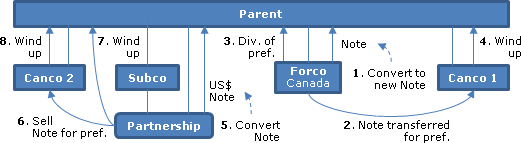
Principal Issues: Upon the transfer of the new note to a subsidiary corporation will the loss denied under 40(2)(e) increase the adjusted cost base (ACB) of the new note ?
Principal Issues: Are the previous rulings affected by the proposed amendments to Ruling 2007-024347, (without the need for a daylight loan and allowing Newco to survive after the loss consolidation arrangement)?
Position: the previous rulings are not affected
Reasons: Set-offs of notes at redemption have been accepted before.
Principal Issues: 1. What is the definition of the term "accountant" as it pertains to the section 34 WIP election?
2. Would a lawyer for bankruptcy qualify for the section 34 WIP election?
Position: 1. In the context of section 34 the term "a business that is a profession" refers to the type of business carried on by individuals who are members of organizations or associations that are governed by statute, that have the power to regulate certification, the issuance of licences to practice the profession, to examine candidates for membership and the right to practice, to establish standards of professional conduct, and to discipline members for infractions of the established standards.
2. It is a question of fact.
Reasons: 1. The term "accountant" is not defined in the Income Tax Act. For CRA purposes an accountant is a professional carrying on a professional business or professional practice.
2. The fact alone that a lawyer is performing certain work, such as a real estate agent or a trustee, is insufficient to determine whether such work constitutes a business that is the professional practice of a lawyer.
Submitted by Anonymous (not verified) on Sun, 11/29/2015 - 02:17
Where a US corporation that is a qualifying person is a 99.99% limited partner of a Delaware limited partnership which, in turn, is a 99.99%...
The text of this content is paywalled except for the first five days of each month. Subscribe or log in for unrestricted access.
Principal Issues: Application of ownership test in Article X(2)(a) of Convention, as amended by the Fifth Protocol, to dividends paid by a Canadian corporation to a partnership where a portion of the dividends is considered to be derived by a company that is a resident of the United States through another partnership that is a partner of the recipient partnership.
Position: In the circumstances described, the U.S.-resident company will be considered to own more than 10% of the voting shares of the corporation paying the dividend.
Reasons: The recipient partnership holds all of the shares of the Canadian corporation paying the dividend. As the U.S.-resident company is a partner of a partnership (the "top-tier partnership") that is a partner of the recipient partnership, the U.S.-resident company will be considered to have an ownership interest in the recipient partnership in proportion to its interest in the top-tier partnership. As the U.S.-resident company holds a 99.99% interest in the top-tier partnership, which in turn holds a 99.99% interest in the recipient partnership, the U.S.-resident company's ownership interest in the recipient partnership will be 99.98%, and therefore the U.S.-resident company will be considered to own 99.98% of the dividend payer's shares for the purposes of Article X(2)(a).
Submitted by Anonymous (not verified) on Sun, 11/29/2015 - 02:15
partnership can be holding partnership holding an active lower-tier partnership
Where a top-tier general partnership holding an interest in a lower-tier partnership is wound-up so that the surviving partner of the former...
The text of this content is paywalled except for the first five days of each month. Subscribe or log in for unrestricted access.
Principal Issues: 1. Does subsection 98(5) of the Act apply to a wind-up of a partnership in a tiered partnership arrangement?
2. Would subsection 98(5) of the Act apply where, prior to its wind-up, the partnership's only activity was ownership of shares in a corporation?
Position: Insufficient information to conclude. However, based on certain assumptions, it is possible that 98(5) could apply.
Reasons: Our reading of the legislation. Consistent with other positions taken.
Principal Issues: Whether children's swimming lessons held for 2 weeks, meeting five times per week, 45 minutes per lesson, qualify as a prescribed program of physical activity.
Position: Possibly.
Reasons: The legislation requires that the duration be five or more consecutive days but does not require a minimum daily duration time.
Principal Issues: Whether an organization is exempt from tax under Part 1 throughout a taxation year by virtue of paragraph 149(1)(d) or 149(1)(d.1) of the Income Tax Act.
Principal Issues: The corporate taxpayer sold the assets of its business and will be subject to CMT as 50% of the gain on the sale of goodwill will be subject to income tax. However, 100% of the gain is included in accounting income and subject to CMT. Can the corporation utilize the CMT credits subsequent to the acquisition of control?
Position: The CMT credits will not be deductible after the acquisition of control as the same business will not be continued by the corporation.
Reasons: The principles underlying subsection 111(5) of the ITA will be applied for interpreting subsection 53(7) of the TA. Subsection 111(5) of the ITA does not allow the deduction of non-capital losses after an acquisition of control of a corporation unless the business that generated the losses is continued.
In this case all of the assets are sold and the business has ceased operations, all that remains is the shell corporation. Therefore, the business that generated the losses will not be continued and the CMT credits will not be deductible.
Principales Questions: Est-ce qu'une résidence pour personnes âgées, dont une partie de la construction s'est faite après le 18 mars 2007, peut se qualifier au titre d'un bâtiment non-résidentiel admissible?
Position Adoptée: Non.
Raisons: Il est nécessaire d'examiner l'usage qu'en font les résidents. Ici, la résidence pour personnes âgées est clairement utilisée à des fins résidentielles - pour ses utilisateurs - et ne peut donner droit à la DPA accélérée.