Submitted by Anonymous (not verified) on Sun, 11/29/2015 - 02:15
Plan of Arrangement
Under a Plan of Arrangement:
Rights under rights plans of Target were cancelled and Target stock options, RSUs and DSUs were...
The text of this content is paywalled except for the first five days of each month. Subscribe or log in for unrestricted access.
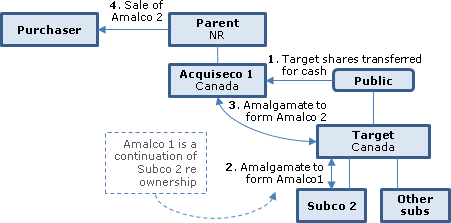
Principal Issues: Acquisico 1 acquired the shares of Target. Target then amalgamates with a wholly-owned subsidiary (Subco 2) to form Amalco 1. Acquisico 1 then amalgamates with Amalco 1 to form Amalco 2, and the latter designates an amount under 88(1)(d). (1) When is control of the subsidiary referred to in 88(1)(c)(vi) (namely, Amalco 1) acquired? (2) Would the acquisition by Target or Subco 2 of of assets of Amalco 1 acquired by Amalco 2 or of property substituted therefor taint the bump under 88(1)(c)(vi)(B)(I) as a result of 88(4) being applied to (i) make Target a specified shareholder of Amalco 1; (ii) make Subco 2 a specified shareholder of Amalco 1; (iii) make Target and Subco 2 the same corporation as and a continuation of Amalco 1 (i.e. the subsidiary for the purposes of that definition).
Position: (1) Based on the presumption of subsection 88(4), control of Amalco 1 was acquired when Acquisico 1 acquired control of Target and Subco 2. (2) We can ignore acquisitions of property by Target. Acquisitions by other companies of the Target group other than Subco 2 would have to be examined separately.
Reasons: (1) The amalgamation of Target and Subco 2 does not result in an acquisition of control of Amalco 1 but Amalco 1 is deemed to be a continuation of its predecessors for the purposes of 88(1) (88(4)). (2) 88(1)(c)(vi) is generally meant to prevent subsequent sale back of bumped assets and 88(1)(c.2)(iii)(B) precludes a corporation from being a specified shareholder of itself.
Principal Issues: Will interest on money borrowed to invest in mutual fund trust units continue to be deductible when all distributions of income are reinvested in the same mutual fund trust, the unit holder subsequently sells exactly the same number of mutual fund trust units that were purchased through the reinvestment and uses the proceeds to pay part or all of the interest on the loan for the year.
Position: Only partially. Future interest on the borrowed money applicable to the prorated portion of original units disposed of will not continue to be deductible.
Reasons: Requirements of paragraph 20(1)(c) have not been met.
Principal Issues: Whether a hockey training allowance paid by a third party in favour of hockey players is taxable as a bursary or scholarship.
Position: In light of the information provided, no.
Reasons: The hockey training allowance is not a bursary or a schorlarship because it is not given to students to enable them to pursue their education.
Marie-Claude Hébert,
XXXXXXXXXX Lawyer
2008-026494
June 3, 2008
Submitted by narmstrong on Sat, 03/13/2021 - 11:22
no T4A required by individual in personal capacity paying for professional or home-repair services
Regarding its policies as to the requirement to issue T4As for fees paid in excess of $500, CRA stated that it “will not insist on the issuance...
The text of this content is paywalled except for the first five days of each month. Subscribe or log in for unrestricted access.
Principales Questions: Quelle est la politique de l'Agence du revenu du Canada relativement à l'émission des feuillets T4A lorsque des honoraires supérieurs à 500$ sont versés?
Position Adoptée: L'Agence du revenu du Canada n'insistera pas sur l'émission d'un T4A dans les situations énumérées dans le Guide RC4157. Elle n'exigera pas non plus qu'un T4A soit émis dans les circonstances suivantes:
(1) lorsque le paiement effectué est inférieur à 500$, dans la mesure où aucun impôt n'est retenu à l'égard du paiement;
(2) lorsque des services sont rendus à un particulier, à titre personnel, par un professionnel ou toute autre personne qui exerce un métier, ou dans les cas où les services sont rendus pour la réparation ou l'entretien de la résidence principale d'un particulier.
Raisons: Politique de l'Agence du revenu du Canada.
Submitted by narmstrong on Sat, 03/13/2021 - 12:39
benefit on sole shareholder whose parents were the occupants of the corporate-owned home
Where the parents of the shareholder of a farming corporation have the exclusive use of a residence owned by the corporation at no charge, is a s....
The text of this content is paywalled except for the first five days of each month. Subscribe or log in for unrestricted access.
Principal Issues: In a given situation, where the parents of the shareholder of a corporation have the exclusive use of a residence owned by the corporation at no charge, whether it could be considered for the purposes of subsection 15(1) that the corporation conferred a benefit either to the shareholder or the parents?
Position: Yes, to the shareholder.
Reasons: Subsection 15(1) could not apply to the parents since they are not shareholders or contemplating becoming shareholders of the corporation. Subsection 15(1) could apply to the shareholder, because of paragraph 4 of IT 432R2 and that in a situation such as the given situation the CRA would assume that the corporation gives the exclusive use of the house free of charge according to its shareholder's direction.
Submitted by narmstrong on Sat, 03/13/2021 - 16:15
broad range of fees, reimbursements and honoraria paid by health centre required to be reported, but exclusive of GST
A health and social services centre is required to issue a T4A slip for various payments made to self-employed workers, including: reimbursement...
The text of this content is paywalled except for the first five days of each month. Subscribe or log in for unrestricted access.
Principales Questions: Est-ce qu'un centre de santé et de services sociaux ("CSSS") doit émettre des feuillets T4A à l'égard du versement des paiements suivants:
(1) Le remboursement des frais de déplacement engagés par des médecins du CSSS qui, dans le cadre de l'exercice de leurs fonctions, doivent se déplacer au domicile de certains patients
(2) Le versement d'honoraires aux médecins provenant de patients non-résident du Canada - non couverts par la RAMQ - qui consultent le service d'urgence du CSSS ou qui sont parfois hospitalisés lors de leur séjour au Canada
(3) Le paiement d'honoraires à des notaires, avocats, architectes et psychologues qui peuvent soit émettre des factures en leur nom personnel ou par l'intermédiaire de leurs sociétés
(4) Le versement de sommes à certains professionnels qui fournissent des soins (coiffure, couture, esthétique, pédicure) aux personnes âgées en hébergement au CSSS. Les sommes sont initialement perçues par le CSSS des résidents qui ont requis les services
(5) Le versement d'un salaire hebdomadaire à un prêtre pour des célébrations religieuses pour le bénéfice des résidents
(6) Le versement de sommes à des gardiennes à titre de mandataire d'une fiducie qui administre les fonds d'un service de gardiennage. Les fonds utilisés pour effectuer ces paiements sont versés par une agence gouvernementale et sont déposés directement dans le compte bancaire du CSSS.
Quelle est la position de l'ARC relativement aux questions suivantes :
(7) Quant à l'émission des T4A, est-ce qu'il y a une différence lorsque le médecin qui rend les services est externe et indépendant au CSSS ou s'il s'agit d'un médecin qui pratique habituellement pour le CSSS?
(8) Est-ce que le CSSS doit inclure la TPS facturée par les médecins dans le T4A?
Position Adoptée: (1) à (6) Oui
(7) Le fait que le médecin qui rend les services soit externe et indépendant au CSSS ou qu'il pratique habituellement pour le CSSS pourrait influer sur le type de feuillet à émettre. Si le médecin est un employé du CSSS, le formulaire prescrit est un feuillet T4 et s'il est un travailleur autonome, un feuillet T4A est à utiliser.
(8) Le CSSS ne devrait pas inclure la TPS/TVH sur le feuillet T4A, à moins qu'il soit impossible de faire la distinction entre le montant d'honoraires payés et la TPS.
Raisons: (1) à (6) Aucune exception administrative ou règlementaire visée au paragraphe 200(1) n'est applicable
(7) Voir le guide RC4110
(8) Voir le guide RC4157
Submitted by narmstrong on Sat, 03/13/2021 - 17:33
the 2005-0134731R3 transactions, accommodating “an intergenerational transfer of a family business,” would be abusive surplus stripping if applied to inter-sibling transfer
In explaining why, in contrast to 2005-0134731R3 F (the "Advance Ruling"), the Directorate could not rule on the proposed transactions, it...
The text of this content is paywalled except for the first five days of each month. Subscribe or log in for unrestricted access.
the 2005-0134731R3 transactions, accommodating “an intergenerational transfer of a family business,” would be abusive surplus stripping if applied to inter-sibling transfer
102
Principal Issues: Whether we can rule that the GAAR does not apply to the proposed transactions?
Position: No.
Reasons: The proposed transactions in the ruling request involved proposed transactions similar to those in ruling F 2005-0134731R3 (Previous ITR) in which we gave a favourable ruling regarding the GAAR. However, in many ways the proposed transactions in the ruling request can be distinguished from those in the Previous ITR. On this point, an important distinguishing factor is that the Previous ITR involved an intergenerational transfer of a family business while in the present ruling request, essentially, a minority shareholder is transferring his interest in a business to his sibling. In our opinion, the proposed transactions in the ruling request results in abusive dividend stripping and all the conditions to apply the GAAR are met.
Principal Issues: Where a life insurance policy issued prior to December 2, 1982 is assigned as collateral for a loan in the circumstances required by paragraph 20(1)(e.2) of the Act, must the policyholder determine the net cost of pure insurance?
Position: Yes
Reasons: Subsection 20(1)(e.2) requires the calculation of the net cost of the pure insurance
Calu - CONFERENCE FOR ADVANCED LIFE UNDERWRITING (2008)
Principal Issues:
When calculating the eligible amount of a gift of a life insurance policy, what is the FMV the life insurance policy?
Position:
To establish the FMV of a life insurance policy for the purpose of paragraph 248(31), paragraphs 40 and 41 of Information Circular 89-3 must be taken into account. Furthermore, paragraph 3 of IT-244R3 must be read taking into account this new position.
Principal Issues:
For the purpose of subsection 128.1(9), whether the policyholder who is an individual must use the cash surrender value or the FMV of the policy using the guidelines found in paragraphs 40 and 41 of Information Circular IC 89-3.
Position:
The FMV of the life insurance policy must be used. To establish that FMV, the guidelines in paragraphs 40 and 41 of Information Circular 89-3 must be taken into account.
Submitted by narmstrong on Fri, 03/19/2021 - 20:09
initial swimming lesson program for preschoolers qualified notwithstanding that did not contribute initially to cardio-respiratory endurance
In finding that a preschool swimming lessons, where children learn how to take to the water rather than swim, a prescribed program of physical...
The text of this content is paywalled except for the first five days of each month. Subscribe or log in for unrestricted access.
Principales Questions: Est-ce que les cours de natation préscolaires où les enfants apprennent plutôt à apprivoiser l'eau qu'à nager, constituent un programme d'activités physiques visé par règlement aux fins de l'article 118.03 de la Loi de l'impôt sur le revenu?
Position Adoptée: Oui, il s'agit de déterminer si la natation est une activité physique qui satisfait les critères de l'article 9400 du Règlement de l'impôt sur le revenu et non si cette activité satisfait ces mêmes critères pour une personne en particulier.
Raisons: Afin de déterminer si les exigences de l'article 9400 du Règlement de l'impôt sur le revenu sont respectées, l'Agence du revenu du Canada reconnaît que les sports ou autres activités physiques ne contribuent pas toujours à l'endurance cardiorespiratoire, surtout pendant les périodes d'apprentissage initiales et que l'admissibilité d'un programme aux fins du CICPE doit se fonder sur la nature générale des activités et sur les bienfaits que celles-ci procurent au fil du temps.