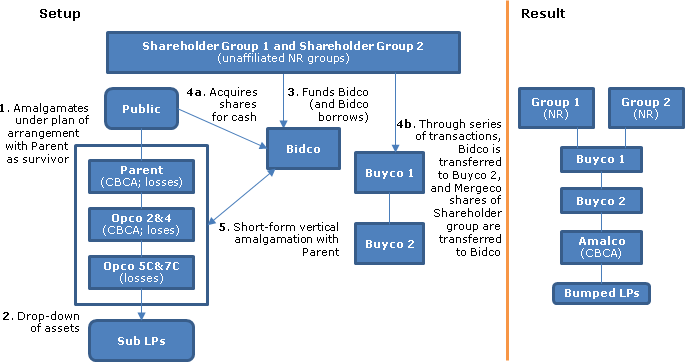
Principal Issues: Packaging by a Target of depreciable property in partnerships. Acquisition of control of the Target. Amalgamation of the Target with the Parent, and bump of the capital property held by the Target (including the partnership interests).
Principal Issues: Is the interest paid on Notes that is based on the index return of a commodity index reflecting the change in value between the issue date and the maturity date exempt under 212(1)(b)(iii)(D)
Position: YES
Reasons: Issuer is a financial institution that is not in business of any of the commodities and the interest is payable in a foreign currency.
Principal Issues: Whether paragraph 118(1)(c.1) of the Act would allow a taxpayer to claim a non-refundable tax credit in respect of a relative who on every other weekend and holidays resides with the taxpayer and at other times resides elsewhere?
Position: No.
Reasons: One of the requirements that must be met in paragraph 118(1)(c.1) of the Act for an individual to be able to claim the non-refundable tax credit in respect of the in-home care of an adult relative is that at any time in the year alone or jointly with others, the individual maintains a self-contained domestic establishment which is the ordinary place of residence of the individual and the cared-for relative. For purposes of paragraph 118(1)(c.1) of the Act a cared-for individual cannot have two ordinary places of residence at the same time or during the course of the year change the ordinary place of residence every other weekend and on holidays.
Principal Issues: Whether a nominal meal allowance or stipend paid to volunteers who receive no remuneration for services provided has to be reported in an information return by the XXXXXXXXXX .
Position: Question of Fact
Reasons: Generally, compensation in excess of a nominal amount paid to a volunteer in the service of some other person would constitute employment income for purposes of the Act. However, nominal amounts paid or reimbursed to volunteers to account for the cost of travel to the location where they volunteer or a meal while volunteering, would generally not be regarded as taxable employment income if that is the only amounts received by the individual. For an individual who is also receiving tips and gratuities, the stipend, tips and gratuities are taxable employment income.
Submitted by narmstrong on Sat, 09/18/2021 - 23:14
election applies to short sales of Canadian securities
Can a taxpayer who is eligible to make an election under s. 39(4) can make that elect on public corporation shares sold short? CRA...
The text of this content is paywalled except for the first five days of each month. Subscribe or log in for unrestricted access.
Principales Questions: Est-ce qu'un contribuable peut faire un choix en vertu du paragraphe 39(4) sur des ventes à découvert d'actions de société publique?
Position Adoptée: Oui, en autant que l'auteur du choix n'est pas un commerçant de valeurs mobilières.
Raisons: IT-479SR, IT-479R. Nous considérons qu'un titre canadien au sens du paragraphe 39(6) comprend un tel titre vendu à découvert
Submitted by narmstrong on Sat, 09/18/2021 - 22:37
fee for credit recognition of work placement might qualify
Regarding fees paid by a student to a university to recognize theoretical and practical knowledge acquired through work experience and for which...
The text of this content is paywalled except for the first five days of each month. Subscribe or log in for unrestricted access.
Principales Questions: Est-ce que des frais déboursés par un étudiant à une université, pour reconnaître des connaissances théoriques et pratiques acquises au moyen d'expérience de travail et pour lesquelles l'université accorde des crédits de cours envers son programme de niveau postsecondaire, peuvent être considérés comme frais de scolarité?
Position Adoptée: En tant que frais accessoires pour un montant ne dépassant pas 250 $.
Principal Issues: What are the rules that must be followed in order for a plan to be a prescribed plan under paragraph 6801(a) of the Regulations and be excepted from the SDA rules?
Principal Issues: Whether the new rules in proposed section 60.011 of the Act that apply for purposes of paragraph 60(l) of the Act allow for a discretionary trust to be the annuitant under a life annuity.
Position: Question of fact
Reasons: The rules that apply for life annuities wherein the annuitant is a trust is different for annuities acquired before 2006 and those acquired after 2005. While the fact that a trust has discretion will not, of itself, determine the issue for pre-2006, there are limits to the amount of discretion that a trust may have for annuities acquired after 2005. However, in either case, it is a question of fact whether an annuity satisfies all of the condition in section 60.011 of the Act.
Principal Issues: What is the role of subsection 104(24) in computing a trust beneficiary's income?
Position: If an amount has, with regard to subsection 104(24), become payable to a beneficiary by a trust, the determination of whether that amount must be included in the beneficiary's income for tax purposes is not made under subsection 104(24) of the Act. Rather, the determination of whether and, if so, when the amount must be included in the beneficiary's income is made with regard to subsection 104(13) of the Act.
Principal Issues: Whether 70(6) rollover available if trustee required to pay life insurance premiums.
Position: No.
Reasons: As a result of the duty to pay life insurance premiums, persons other than the surviving spouse or common-law partner may, before the survivor's death, obtain the use of trust income or capital.
Principal Issues: Can you give an update on CRA's current assessing position with respect to Canadian corporations which hold U.S. real estate which is personal use property (such as a Florida Condominium used as a residence by the Shareholders)?
Position: ITTN#31R2 sets out the requirements to be eligible for the transitional relief under which a 15(1) benefit will not be assessed in respect of a shareholder's use of corporate real estate located in the U.S. Since the release of ITTN#31, the CRA has confirmed that the transitional relief for property transferred to a spouse as a consequence of death will also apply to the transfer of property to a post-71 spousal or common-law partner trust as a consequence of death. The CRA also confirmed that the transitional relief would not be available in the situation where the shareholder who contributed the property redeems his shares such that the remaining shareholders have use of the property.
Reasons: In the second scenario, the requirements set out in ITTN#31 are not met.
Principal Issues: At last year's STEP conference, we addressed the issue of whether a trust that only held property that was subject to subsection 75(2) of the Act was required to file a T3 return. As stated in the 2004 and 2005 T3 Guides, a trust that holds property that is subject to subsection 75(2) of the Act is required to file a T3 return regardless of whether or not it has tax payable or meets any of the other conditions relating to dispositions and distributions of trust property that would give rise to an obligation to file an income tax return. Certain commentators have challenged your position on this issue, on the basis that subsection 150(1.1) of the Act provides an exemption for individuals, which presumably includes trusts, that have no tax payable for a particular taxation year. Can you comment any further on this issue?
Position: A T3 return is required whenever 75(2) applies to attribute any of the income of the trust to a contributor.
Reasons: Section 221 of the Act contains a broad range of prescribing powers, including the powers to promulgate regulations imposing requirements to file information returns. Therefore, given the nature of the T3 return as both a return of income and an information return, the statutory requirement to file a T3 return exists where the trustee has control of or receives income, gains or profits in the trustee's fiduciary capacity, even if the trustee computes nil income for the trust for tax purposes. This includes circumstances where the trust has no income for tax purposes because of subsection 75(2) of the Act.
Principal Issues: When subsection 75(2) of the Act applies to shares of a foreign corporation held by a trust that is taxable under paragraph 94(1)(c) of the Act, how does one determine the amount to be attributed to the contributor? In particular, can the amount of income that was attributed to the contributor be changed if the foreign corporation realizes a loss in a subsequent year?
Position: The income or loss from property, or taxable capital gains or allowable capital losses from the disposition of property are to be computed in accordance with Division B of Part I of the Act; thus section 91 is the appropriate taxing provision for the contributor when subsection 75(2) applies. The calculation under 94(1)(c)(i)(C) is not appropriate because 94(1)(c)(i)(C) is a component of the trust's total taxable income and does not necessarily reflect the net income from any particular property. If the Trust realizes a loss as computed under regulation 5903, the loss can be applied by the contributor in the other years, as permitted by regulation 5903 provided that 75(2) applies in the loss year.
Principal Issues: Who is the majority-interest beneficiary in an unadministered estate for the purpose of subsection 251.1(1) of the Act? Some commentators have noted that it may be difficult to determine each beneficiary's share of the income and capital of the estate if the amount of the testamentary debts is not known. For example, if one beneficiary is entitled to a specific bequest of $100,000 and the other beneficiary is entitled to the residue of the estate, the determination of who is entitled to the majority of the capital of the estate depends on the amount of capital available to be distributed to the beneficiaries after the payment of all of the testamentary debts.
Principal Issues: Whether an outlay or expense made or incurred by a deceased taxpayer's estate in respect of a deemed disposition under subsection 70(5) may be recognized in computing under subsection 40(1) the deceased taxpayer's gain or loss arising from that disposition.
Position: No.
Reasons: The deceased taxpayer and the estate are separate taxpayers. Therefore, expenses or outlays made or incurred by the estate cannot be claimed in computing the deceased taxpayer's gain or loss. More generally, expenses or outlays with respect to deemed dispositions are considered to be made for the purposes of computing the proceeds of disposition for tax purposes, not for the purposes of making the disposition. Therefore, provisions such as subsection 40(1) that require that an outlay or expense be made or incurred for the purposes of making a disposition will not apply in respect of deemed dispositions.
Principal Issues: A bare trust is not recognized for the purpose of the Act because subsection 104(1) of the Act profides that, in situations where the trustee can reasonably be considered to act as agent for all the beneficiaries in respect of all dealings with the trust property and the trust is not a trust described in any of paragraphs (a) to (e.1) of the definition "trust" in subsection 108(1), the arrangement is not considered to be a trust for all but a few purposes of the Act. When an individual transfers property to a bare trust, no disposition is recognized because there is no change in beneficial ownership. However, paragraph (b)(v) of the definition of "disposition" in subsection 248(1) of the Act has the effect of creating a disposition when the trustee of a bare trust ceases to act as such in respect of the trust property. One interpretation of this provision would result in a disposition whenever a bare trustee distributes the property back to the sole beneficiary of the turst who is also the sole contributor to the trust. Can you comment on this?
Position: No disposition arises on the distribution of the trust's property to the contributor who is the beneficiary of the bare trust.
Reasons: Since paragraph (e) of the definition is not one of the provisions for which a bare trust is considered to be a trust, the exceptions in paragraph (e) will not apply to the distribution of the bare trust's property to the contributor-beneficiary. Since there is no change in the beneficial ownership as a result of the distribution, paragraph (e) will apply and the distribution will not result in a disposition. If a trusee ceases to act as agent for all the beneficiaries in respect of all dealings with the trust property without a distribution to the beneficiary, subparagraph (b)(v) will operate to ensure that a disposition arises at the time. Also, a disposition will arise at any time when there is any change in beneficial ownership that is not covered by the exception in paragraph (e) of the definition of disposition (such as the transfer of property from one person to a bare trust for another person.
Principal Issues: As of 2004, the T3 slip requires the trustee to show the amount of any adjustments to the ACB of the beneficiary's interest in the trust in Box 42. We are told that some brokers combine the information from various trusts to create one T3 slip. How is a unitholder expected to compute the adjustment for each fund if this is the case?
Position: This question raises two issues, the ability of the information preparer to issue a consolidated T3 slip and the investor's dilemma of computing the capital gain or loss from the disposition of the units correctly, given the interaction of adjustments to the ACB under section 53 (box 42 amounts) and the cost as determined under subsection 248(25.3) of any additional units issued by the trust.
Reasons: See IC92-5 & 93-4 (archived) and attachment for procedure for obtaining approval for a customized T3 slip, including a consolidated T3 Slip. Without approval, a separate T3 slip is required for each Fund. ACB adjustments under 53 include the amounts shown in box 42 for each year in which the units were held as well as any capital distributions received in before 2004. The cost of units acquired as determined under 248(25.3) is not included in box 42 even though it forms part of the cost of the units so acquired.
Principal Issues: Can you give an update on any changes that are being proposed to the way T3's are assessed? In particular, there has been some discussion about whether financial statements for trusts will be required in the future. What is the current thinking on this matter?
Position: The AG has recommended that a statement of assets and liabilities (a balance sheet) be required to be filed with the T3 return; her recommendation is under consideration
Reasons: See 2005 AG report, chapter 3 in particular for full details of the AG's recommendations with respect to the assessment and auditing of trusts.
Principal Issues: Whether the comments in the case of Sedona Networks Corporation, 2006 TCC, will affect our position that, where several persons have a right described in paragraph 256(1.4)(a) to acquire the shares owned by the other shareholders, control of the corporation is determined as though the rights are exercised simultaneously?
Position: No.
Reasons: Sedona decision is not inconsistent with our position.
Submitted by Anonymous (not verified) on Sun, 11/29/2015 - 02:13
Although CRA does not apply s. 75(2) to a genuine loan of cash to the trust, this position does not extend to a loan of income-producing property...
The text of this content is paywalled except for the first five days of each month. Subscribe or log in for unrestricted access.
Principal Issues: Interpretation Bulletin IT-258 states that a genuine loan to a trust would not by itself result in property being "held" by the trust under one or more of the conditions under which subsection 75(2) of the Act applies, provided that the loan was outside and independent of the terms of the trust. However, CRA document 2000-0023997 seems to contradict this position. Can you clarify the CRA's current position on the application of subsection 75(2) of the Act when a beneficiary or trustee makes a genuine loan to the trust?
Position: The position set out at the 1991 CTF differs from the situation described in subsequent letters, including CRA document 2000-0023997 & 2000-001255.
Reasons: Our position with respect to the application of 75(2) of the Act to a cash loan remains as stated at the 1991 Canadian Tax Foundation, but various subsequent documents describe the result in other situations. Document 2000-0023997 distinguishes this position from the tax result that would occur an income-producing property other than cash were to be loaned to a trust. In such a case, the transaction fits squarely within the type of situation described in subparagraph 75(2)(a)(i) of the Act because the trust is holding the income-producing property on the condition and in full expectation of returning the property to the transferor. Similarly, while the CRA does not apply subsection 75(2) to a genuine loan of cash, including a conditional sales agreement for the sale of property, solely by reason of the fact that the outstanding debt will be repaid, subsection 75(2) of the Act does apply if a capital beneficiary of a trust transfers property to that trust, regardless of whether or not the capital beneficiary receives fair market value consideration.